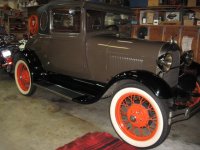
Any Lacquer cars out there?

Craig Lewis

Well-known member
Has anybody here had their car body refinished in lacquer?
I'm talking NO clear coat....but polished out exactly like Henry did it.

Would you do it again?
How come?

Thanks a heap as usual for any and ALL advice :):):)
 
I used nitrocelulous and acrylic lacquer on 3 of my restorations back in the 70s. As of now some of the acrylic lacquer is starting to check, but the nitrocelulose is still ok after 35+ years. I think the single stage urethane enamels are far superior to the lacquers but be carefull not to breathe their fumes or get them on your skin. They're poison.
 
I sprayed the body for my '30 Coupe with acrylic lacquer twenty years ago and have switched to acrylic urethane since then. I would not use the lacquer again, it simply doesn't age well. Gar Williams
 
Lacquer will soften in the hot sun. It will expand and shrink because of this and it can cause the paint to fail with cracking and crazing. It will oxidize quickly and frequently. That is why we used to wax our cars every month.
It will also have poor abrasion resistance and over time as previously said it will crack and craze and alligator.
I would use the new Urethane paints such as PPG Concept (single stage not base /clear coat)and not have any of the above problems. It is a chemical cure where by the molecules will cross link. It will give you a better, more durable finish and it will still look like lacquer. Go to any body shop and ask them what they are using? Not one will say they are using lacquer as they are all using urethane finishes. Of course they use base/ clear but that looks like plastic and does not look like laquer when done. Base/ clear looks great on a street rod or a Corvette but looks to plastic on an antique car. Use single stage urethane and buff it out like lacquer,
Ken
 
Thanks for the comments guys!

The lacquer I see at tcpglobal/autocolour library... appears to be "acrylic" lacquer.

Q) Is nitrocellulous lacquer available anywhere?

Q) I wonder if lacquer would holdup appreciably better over todays epoxy & high solid primers?
....or has someone tried that already :confused::confused:
 
Total thickness is a critical factor.

A new car is about 75 microns or 3 thou.

150 microns total is the max on any respray.

Most cracking and crowsfooting is too thick paint.
 
Q) I wonder if lacquer would holdup appreciably better over todays epoxy & high solid primers?
....or has someone tried that already :confused::confused:[/QUOTE]

The lacquer on my Coupe is over Ditzler DP-40. The primer remains fine, it's the two crosscoats of lacquer that is deteroriating, especially on the top of the fuel tank where it has been exposed to fuel. Gar Williams
 
There are plenty of examples of older former high point show cars that have been painted with lacquer, nitro and acrylic. Nothing beats a hand rubbed finish, case in point, Dave Cella's 492pt '28 coupe. When shown at the 2006 MAFCA National, the car just jumped out among the other base/clear and urethane vehicles. One of the nicest 68-Bs I've ever seen still stands strong with a circa 1970 nitro job. The man who restored the car did the body work first and the paint sat for nearly a year before he rubbed it out. My 150-B was painted in 1974 with nitro and has held up nicely, even through a period where it was used regularly at the beach on Cape Cod. My two original cars with their OP have held up spectacularly.

Lacquer is more forgiving than these modern paints and the hobbiest does not need all the expensive safety equipment and paint booths the new stuff requires for health considerations. Folks have strong opinions about paint and I'm not trying to change people's minds. I just know what I've seen work, what has worked for me and I plan to do two more cars in lacquer while I can still get it.
 
My 1931 SW Sedan was painted with Nitrocelulous in 1957. It was completed in time for the 1957 MARC National at Greenfield Village.

In 2007 at the Williamsburg MARC National there were any number of folks that could not believe the lacquer had held up for all those years. While the paint in not perfect it sure hasn't cracked or crazed. The car still "shows" well.

I polish it once a year and the car is covered when parked. It has always been kept in a darkened garage with bed sheets for covers.

Would I use Nitrocelulous again. Probably not. But the paint on the sedan has sure stood the test of time.

http://www.largescaleonline.com/eimages/lsolpics/Team_Member_Pics/jlsrails/s_100_4213.jpg
 
Last edited:
Here are fairly recent photos of three lacquer paint jobs. The first, our August 1928 49-A Special Coupe, was painted in 1989-1990, with Ditzler acrylic lacquer, no clear. After 21 years the paint has shrunk a bit, but no checking or flaking anywhere. I would like to wet sand and buff again, but since I don't have a drop of spare paint, I will leave it as is, to age however it wants to. I took this photo this year while cruising around town.

The photo of our June 1928 35-A Phaeton was taken in June at the French Lick, Indiana meet. The Phaeton was painted in 1999-2000 with Ditzler acrylic lacquer, no clear. It too has shrunk a bit. No crazing anywhere. I have developed a couple of very small cracks on the hood by the hinge from the flexing, I guess. The shrinking of the paint will trigger me to wet sand and buff a couple of spots sometime in the future, but I just ignore them for now.

The photo of our July 1929 165-A Fordor is a couple of years old. It is the factory nitro-lacquer paint, with factory enamel fenders. The body shows zero crazing, and is very shiny all over. There are some areas that are getting very thin, especially the hood. Also, there is some damage from a prior owner's spilling something on it while cleaning out the gas tank. Oh well. The car was very dull all over, zero shine, when we purchased it. All I did was polish and wax it. You can see how the shine continues after 81 years.

We wax our cars maybe once a year. They don't sit in the sun very much, and are kept indoors whenever we are not driving or showing them. They don't require much up-keep is my point. We live in a pretty dry climate, which obviously contributes to the ease of care.

With all that said, I will not paint another car in lacquer. Why not, if these paint jobs are so nice? Well, look at the fenders. I painted our Coupe and Phaeton black sheetmetal in Centari and PPG Concept, respectively. Those paints don't seem to shrink, and if they do, it is so negligible, I haven't noticed. I know firsthand how much easier lacquer is to use, how forgiving it can be, and how easy it is to touch up. But, the lacquer will chip so much easier than the modern paints and if shrinks after time, without fail, causing the need for wet sanding and buffing out to maintain the original shine. After nearly 2,000 miles on the Phaeton, there isn't one chip on the underside of the fenders. And, I've heard lots of pebbles hitting the undersides! No, no more lacquer for me.

Dave Lopes
 

Attachments

  • 100_7285.jpg
    100_7285.jpg
    106.9 KB · Views: 110
  • 28 Phaeton at French Lick 2010 LOW RES 2  .jpg
    28 Phaeton at French Lick 2010 LOW RES 2 .jpg
    105.6 KB · Views: 103
  • 29 Fordor f-r LOW RES   .jpg
    29 Fordor f-r LOW RES .jpg
    95.6 KB · Views: 107
Dave --

Pretty cars ... and nice paint. Would you be kind enough to share the name of the main body color on your coupe?

Thanks --

Dick
 
Thanks for the comments guys!

The lacquer I see at tcpglobal/autocolour library... appears to be "acrylic" lacquer.

Q) Is nitrocellulous lacquer available anywhere?

Q) I wonder if lacquer would holdup appreciably better over todays epoxy & high solid primers?
....or has someone tried that already :confused::confused:


I used acrylic lacquer on my 1966 Corvette in 1980. It still looks good today. no checking, but it stays inside when it is not being driven.
 
Like others have said, sun seems to be the issue as well as thickness. One I did in nitro in 1969 still is good. Another in acrylic lacquer in 1987 still is good. In both cases they don't set out in the sun. It seems I've seen nitro advertised somewhere, maybe Hemmings. Hibernia (sp.)?
 
I forgot to mention that it seemed the problem with the lacquer jobs cracking stemmed from too much build up due to too many coats. I recall my mentor telling me that six coats were plenty. The cars were originally sprayed with two double coats and the paint on my original fordor and coupe has really held up well, only thinning in spots as Dave has described with his outstanding original car.
 

Attachments

  • IMG_0505.JPG
    IMG_0505.JPG
    79.7 KB · Views: 39
  • IMG_0514.JPG
    IMG_0514.JPG
    94.7 KB · Views: 38
  • IMG_0507.JPG
    IMG_0507.JPG
    77.3 KB · Views: 45
Hey guys thanks for the great input & pictures! :)
1) For the black, I've ordered concept acrylic urethane as it's undisputedly a great product for high wear areas (fenders & aprons)
2) For the colour, I've decided to NOT decide.
You see... yesterday they mixed me a sample of brewster green IM1017 and it's lighter by FAR than the chips in both the mafca and the old Ditzler manual.
....I like it dark....
I realize we can work with toners till it looks dark....but when I finally spray the car this product will be long extinct. What if I don't don't like it? I'll never be able to tint it or match it :eek:
As previously noted I've felt an urgency to obtain good quality paint in these final days before it becomes obsolete in Canada....and then I would do all the body repairs and prep while the paint aged on the shelf. In reality , there will still be paint available for my Model A when the time comes....maybe better.... maybe not.
...which leads to my final confession;)
Maybe this old car would be "happier" in nitrocelulous lacquer.
It sounds more durable than acrylic lacquer for some reason and it's stood the test of time with 20 -30 year old jobs together with some 80 year old originals!
I've noticed these lacquer reports come from credible sources...folks with pictures & even awards to back up their story.:)
Lacquer would be easy to work with on a car in many pieces. Certain parts could be easily painted (or scratches repaired) as it goes together and I wouldn't have to deal with flattening agent for all the inners... it would be semiglass as intended...slam the doors & polish the outside....done! :)
Unless something "better" exists on paint day...I'm leaning towards nitro lacquer.
I realize it's softer, but as with most Model A's it'll be meticulously cared for.
If it lasts 25 years, I'll be old & checked & crazed too.
.....dunno bout the shrinking :rolleyes:
 
Reply to Dick Carne's question;

Our Special Coupe is painted Gunmetal Blue, which as you can see, is more green than blue. The color in the photo is fairly accurate on my computer screen, so it may be on yours, depending on yoour settings. It was color matched to a couple of areas on the car that retained some original paint, so it is pretty accurate. This color combo of Gunmetal Blue with black belt and mouldings, and the French Gray reveals, is no longer in the Paint Guide of Judging Standards. Too bad, as I thought it was a great combo. I decided to paint it those colors after viewing a '28 Tudor restored by Archie Jackson years ago.

The Phaeton is Niagra Blue Light, with Duchess Blue belt, French Gray stripe. The Fordor is Andalucite Blue and black uppper, French Gray stripe.

Dave Lopes
 
Dave --

Thanks for your kind response. Again, great looking cars! My daughter and her husband are looking to paint their '29 Murray fordor a dark blue, and having seen your coupe, thought I might suggest this color to them. I too, like the black trim and French Gray stripe. Mighty classy.

Thanks again --

Dick
 
My 29 Coupe was shot with acrylic lacquer 25 years ago, still holding up well. Still have the original left over half gallon of each color and strained it after mixing and put it into new cans, the stuffs great. I shoot all my choppers in PPG single stage CONCEPT Acrylic Urethane. I wet sand with 2000 grit and use a 3M buffing compound after that. Clear coat will never take the place of a hand finished paint job.:)
 

Attachments

  • IMG_5501.jpg
    IMG_5501.jpg
    178.1 KB · Views: 12
  • noid-img_1772.jpg
    noid-img_1772.jpg
    280.6 KB · Views: 12
  • IMG_5789.JPG
    IMG_5789.JPG
    117.6 KB · Views: 14
Back
Top