Checking radiator for overheating problem with 1956 Thunderbird

There is a lot of controversy regarding whether or not to add the steam holes. You'll find an in-depth discussion on y-blocksforever.com. I think the consensus is don't plug existing holes, but don't add holes. Also, there could be sealing issues using gaskets with holes if your engine doesn't have the holes.
The owner of the old-school machine shop that rebuilt my two Y-blocks recommended leaving the blocks & heads 'as-is', without additional holes.
.
 
Last edited:
It's a brief paragraph & description of how to use these two pre-cut holes in the head gaskets as a template to mark the block & heads for a pair of added holes and the drilling process: start with smaller bits and work up to the final size of...

11/64 for the upper hole and 1/4 for the lower hole.

THANK YOU! for that info ... ;)
 
There is a lot of controversy regarding whether or not to add the steam holes. You'll find an in-depth discussion on y-blocksforever.com. I think the consensus is don't plug existing holes, but don't add holes. Also, there could be sealing issues using gaskets with holes if your engine doesn't have the holes.

!!! VERY IMPORTANT POINT !!!​

As hot as some of these BIRDS get, I wonder why there are not more failures.

Here is the info thread from y-blocksforever -

http://forums.y-blocksforever.com/Topic161908.aspx?Update=1#bm161912
 
- INFO BROUGHT OVER FROM y-blocks.forever -​

DANIEL TINDER (9/3/2022)

Florida_Phil (6/11/2022)


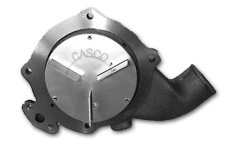
I learned that Tbirds have a 1" spacer behind the water pump that causes water flow issues at idle speeds. I installed a Casco improved water pump with longer blades and this worked great.


Phil,

Which gen. CASCO pump do you have?

While speaking with Chris (Paragon) re: his improved spacer design, the subject of 1st gen. Casco riveted pump blade failures came up.

With my coolant drained & fan removed, I noticed a subtle tinkling sound when spinning the pump shaft (loose rivets?). According to Chris, when those blades finally do come off, they sometimes make a hole in the spacer, and result in sudden coolant loss. Current 3rd. gen. pumps have a solid impeller with deeper vanes, and they can upgrade your pump ($50), something I plan to do though I have to wonder how much life is left in the pump bearings after running their (nose-heavy) clutch fan setup for over 25K miles? (no discernible side play, but impeller/shaft DOES spin quite easily).


SOURCE - http://forums.y-blocksforever.com/P...eIndex=4&Task=PostQuotedReply&ParentID=162051
 

Attachments

  • WP - HI-FLO _2 - BIRD - Development - CASCO - BIRD - Development - WP Impellar Install - CASCO 8.jpg
    WP - HI-FLO _2 - BIRD - Development - CASCO - BIRD - Development - WP Impellar Install - CASCO 8.jpg
    21.3 KB · Views: 14
Another excerpt from :D !!! - Y-BlocksForvever - !!! :D

Sand/dirt build up in the blocks is common but I don't think it's casting sand. This is not just a Y-Block nuance but all engines in general. I call it ‘Mud’ and it gets packed in there very tightly or hard. Most older engines in the shop for rebuild have it and it is attributed to using tap water for the cooling system. While distilled water is recommended for cooling system use, that is not a standard practice. That ‘Mud’ typically accumulates at the back of the block around the rear cylinders where the water flow is slowest and then has to transition up to the cylinder heads to make its way forward to exit the engine. That transition upwards has the solids in the coolant dropping out at that point. Because it accumulates mostly around the rear cylinders, it does add to abnormal heating of the engine at the rear of the block. Not thoroughly cleaning the block during the rebuilding process has that new engine running hotter than normal than it should.

Removing it requires some serious cleaning of which manually breaking it up and digging it out is required before actually doing a wash on the block. Using a caustic tank or wash initially is not enough to remove that sludge without some initial digging first. The really bad blocks will have a quart or more of that sludge in each side.

- TED EATON

Read thru the entire thread here - http://forums.y-blocksforever.com/Topic161202-1.aspx

EDIT - ADD'L INFO

If you folks install aluminum radiators, aluminum timing covers, aluminum heads, or aluminum intake manifolds, you should consider using anti-freeze that is designed for aluminum parts. If you don't you will have a short lived radiator, or corroded aluminum engine part. Joe-JDC

ADDENDUM- (Fr. For Edit)

Originally Posted by dmsfrr

This linked page covers much of the overheating problems but folks may not be aware of it.

https://www.ctci.org/1955-56-57-thun...d-overheating/

11- See page 386 & 387 of the restoration manual on how to relieve hot spots between 2 & 3 cylinders on the right bank and 6 & 7 cylinders on the left bank of the engine block.

It's a brief paragraph & description of how to use these two pre-cut holes in the head gaskets as a template to mark the block & heads for a pair of added holes and the drilling process: start with smaller bits and work up to the final size of... 11/64 for the upper hole and 1/4 for the lower hole.

There is a lot to consider and figure to solve the problem(s) in one fell swoop.
 
Last edited:
I am not to sure just what the purpose of the baffle plate between the water pump and the timing case is, I have never seem one on a truck Y block. I don't think it is a spacer plate because the plate is only about 16/18 gauge which is less than 1/16 of an inch.

You are describing the actual WP spacer (8A510) as used on the BIRD exclusively?

... chirp ... chirp ... chirp ... :confused:​

https://www.classictbird.com/pdf/H2O-pump-test-results.pdf

The baffle plate is shown and discussed at the link above.
.

If what is being discussed as a baffle plate is as shown below, it is ineffective and not needed -
 

Attachments

  • WP SPACER (8A510) - COOLANT BAFFLE - BIRD.jpg
    WP SPACER (8A510) - COOLANT BAFFLE - BIRD.jpg
    12.8 KB · Views: 5
Last edited:
Regarding the overflow tube, are you saying a very short metal tube is soldered to the filler neck, and then a flexible tube (rubber hose) is attached to that and routed across the top and down the side of the radiator? My tube is metal across the top and down the side. The end of the tube is wider than the rest of the tube and looks like it could be soldered to the neck.

The overflow tube being metal is for safety. If you open the cap (1st safety position) while checking coolant level (while hot), the coolant will scald your fingers instead of being discharged to the ground.

Reproduction tubes are available.

*****​

Just because the bypass hose leaked does not mean it's overheating - it just mean you have a leak at pressure.

But it will overheat @ some point, if not overheating when the leak is discovered. You have a loss of coolant volume and loss of system pressure which will lower the boiling point of the coolant still left in the system.
 
Last edited:
There is no problem running a rubber hose as the overflow tube. My 48 with a 302 has been running one for 40 years.


My 56 Bird has the overflow tube on the right (passenger side) with what looks like a stock radiator.
 
There is no problem running a rubber hose as the overflow tube.

Paul, you forgot to add IMO.

IMO, one would want to keep (I would hope) a BIRD as original as possible. We aren't talking RESTO-MOD here.

If someone just wants a cheap fix, AUTOZONE is the place to be to ask questions.
 
And we are not talking a Concours car either.


Paul, you forgot to add IMO.

IMO, one would want to keep (I would hope) a BIRD as original as possible. We aren't talking RESTO-MOD here.

If someone just wants a cheap fix, AUTOZONE is the place to be to ask questions.
 
There are certain things you do to an automobile and certain things you don't. I don't think he is using the car as an everyday beater.

Can you guess as to a person's ability when he opens the hood and all that is seen is duct tape and baling wire?
 
I hardly think that a rubber overflow hose is in the same league with duct tape and bailing wire.. Of course, everything had to be done correctly.


Just to let you know, I have a 56 Bird - and I take special pains to make sure anything I do is done correctly, safely and neatly. Same with my other two cars. And I wouldn't suggest to any one else to do something different.


And I resent the hint/suggestion that I would advise someone to do a hack job on a car (or anything else)


There are certain things you do to an automobile and certain things you don't. I don't think he is using the car as an everyday beater.

Can you guess as to a person's ability when he opens the hood and all that is seen is duct tape and baling wire?
 
Back
Top