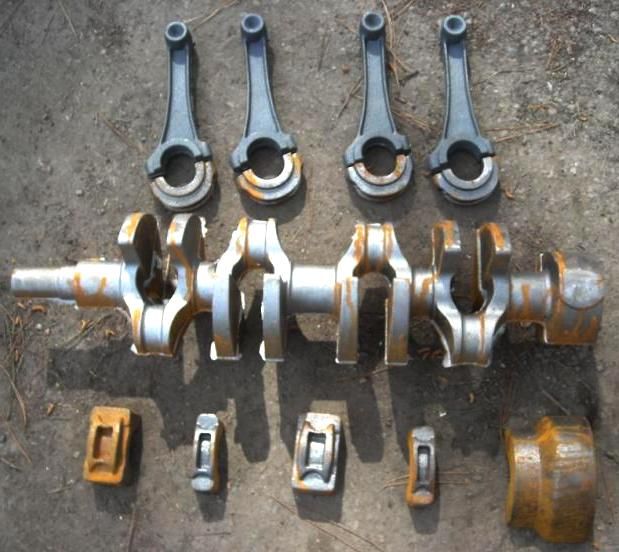
New A Engine from Burtz

Chris Haynes

Well-known member
I recieved an update from Terry Burtz. He tells me that Globe Iron Foundry is now assembling cores. He is hopeful fo see castings soon.
This is the five main bearing block, crank, and rod set.
 
I thought it was going to use the Burlington crank ( no longer available)?? Are you saying he's also making a new crank??
Paul in CT
 
I thought it was going to use the Burlington crank ( no longer available)?? Are you saying he's also making a new crank??
Paul in CT

Paul,
It is a new crank, rods and block, I cant remember, I believe it is 5 main bearings, I wish the 2 contenders making these new engines much luck in there endeavors there will be a little competing for sales which may keep the price reasonable.
 
What exactly is the purpose of such an engine, I wonder, in comparison to a stock engine? Sure, 5 mains compared to 3 will benefit the crank, but are broken crankshafts in A's really a common occurrence?

The way I understand it, the stock A's ability to rev higher is limited by (1) the carburetor and (2) the camshaft, perhaps (3) to some degree valve float. So if somebody uses a stock block, a top-notch crankshaft, insert bearings on mains and rods, Venola pistons, ARP bolts, has everything balanced to the T, then adds a "better" carburetor and camshaft, that engine should rev to at least 4,000 rpm, right? Is at that point the 3-main block the limiting factor, or what warrants spending a lot of money on such a block? Just wondering . . .

 
What exactly is the purpose of such an engine, I wonder, in comparison to a stock engine? Sure, 5 mains compared to 3 will benefit the crank, but are broken crankshafts in A's really a common occurrence?

The way I understand it, the stock A's ability to rev higher is limited by (1) the carburetor and (2) the camshaft, perhaps (3) to some degree valve float. So if somebody uses a stock block, a top-notch crankshaft, insert bearings on mains and rods, Venola pistons, ARP bolts, has everything balanced to the T, then adds a "better" carburetor and camshaft, that engine should rev to at least 4,000 rpm, right? Is at that point the 3-main block the limiting factor, or what warrants spending a lot of money on such a block? Just wondering . . .

Five mains will make a stronger engine. The owner of said engine can add whatever other parts are needed to increase the horsepower and RPM potential.
 
To me a new block with five mains, larger mains and throws, counterbalanced crank, and pressure oiling simply makes good sense. There doesn't seem to be a shortage of original blocks that are rebuildable. I can't see where buying a new replacement block makes sense when you can buy a much improved block.
Terry's new block, crank, and rods will probably be much cheaper than having an original block and crank converted to inserts, counterbalanced crank, and pressure oil. Plus it won't be eighty five year old fatigued metal either.
 
The concept is great, but I can't wait to see what the actual cost of these new blocks will be. The only concern is, if the block is different from a stock Model
A block, that would affect the originality of the car.
Rog
 
I just took four blocks to a shop that cleaned them and found just one that is rebuildable. Like 1000 year old egg, all look good on outside. I would really love to have spent my money on a five main block. Terry Burtz block looks like the Model A on the outside. That was the point of it, to improve to the 1970s technology, or there about.
I'm sure that my rebuild with counter weights and inserts will be well over what Terry is shooting for price wise. And I'll still have 80 year old iron and the crank whip that is so tough on the bearings. Those engines make a lot of sense to me, even if they cost a bit more, I'll buy one just for the reliability. Now I'm a target, Shoot Me!
 
The concept is great, but I can't wait to see what the actual cost of these new blocks will be. The only concern is, if the block is different from a stock Model
A block, that would affect the originality of the car.
Rog

Only the inside of the block is different. The outside looks exactly like Henry's block. Blank number boss so you can put your frame number on the engine.
 
Let me simply assume that somebody who wants a stock looking block will not want to go with a downdraft carburetor and other high speed goodies that lock "out of place" on a stock car. So how much power can a bone-stock looking 5-main block make under such conditions? Wouldn't the carburetor, even if given the works inside, limit horsepower output to about 55 or so? I'm just thinking out loud here.

If money was no object, especially I, with hydraulic brakes, F-100 steering, overdrive, and all those incorrect things would love to have a 4-banger that makes 80hp, revs to 4,000rpm, and allows me to cruise at 75mph on the freeway without risking overheating or terminal damage, sure. But figuring in the cost of such a block with 5-main crankshaft to top it off (which I do not know), I don't see getting to such level without external modifications such as intake, carburetor, exhaust, etc.

Yet, on the other hand, somebody who is looking for more power, won't really mind if the block doesn't look bone stock. What am I missing here?
 
. . .
Yet, on the other hand, somebody who is looking for more power, won't really mind if the block doesn't look bone stock. What am I missing here?

There is quite a large base of vintage speed equipment people who do care about looks. A stock appearing block is paramount to that.
 
There is really no need for a 5 main bearing block and crank. I run a overhead valve motor with new steel crank, high lift cam, 9.5:1 Ross forged pistons, have no need to rev over 4500, and have around 180 hp. The engine has done 3 seasons track racing and never missed a beat.

However, for my 300hp supercharged motor, I will be first in line for the 5 main bearing block!! :D:D
 
I have been gathering parts to use on the block when I get it. A Yapp Riley Two Port, Wico JEM Magnito, Progressive two barrell downdraft kit, Cam & Adjustable lifters, Autolite exhaust manafold heater.
 
There is an extreme advantage I see to the Burtz 5 main crank. The counterweighting is 100%, vs. 60% for the press-on overhang Ford B crank, 40% for the forged countered B, and 40% or less for weld-on A crank weights. Additionally, the weights are equal on both sides of each throw. With a three main crank the weights are all extremely biased on one side, imparting torsional stress at the critical throw radii points that lead to fractures. The crank weighs ~90 lbs vs 50+ for a countered A or B. The mass is where it belongs- in the crank rather than in a heavy rear flywheel.
BurtzCrankshaftampRods.jpg

In addition to the greatly reduced crank harmonics, the material itself, cast nodular/ductile iron is inherently much more absorptive of vibration than a steel forging. The only disadvantage is the material is only good to 400 horsepower or so, hardly a problem for an A engine. Also, the Burtz design will use an actual rear seal, not the slinger or one of the other band-aids found on a stock A.
 
Back
Top